Wednesday, 14 August 2013

Sound bites: unemployment shows Bank of England in for the duration on 0.5% rates

Judging by the slow rate of attrition in UK unemployment coming down, it looks like the Bank of England will be in for the duration on record low interest rates. Waiting for headline unemployment to come down from 7.8% to the key 7.0% policy threshold will be like watching wet paint drying. Conditionally, it is going to take a long time. The only potential circuit breaker that might engage quicker tightening from the Bank is the budding UK housing bubble. It seems as if a lot of the BOE’s monetary largesse is now being funnelled into the UK housing market. While this might be a good thing for rebuilding consumer confidence, the Bank will not want to see this unfold at the expense of its inflation targets. Headline UK inflation has only been allowed to live above its 2% target for so long out of consideration for the recession. That might change quite quickly if the UK housing market begins to show signs of heating up too quickly. It could spell the risk of the BOE bringing forward its expected rate tightening from 2015, earlier into 2014. This should continue to provide continuing support for sterling and intensify steepening pressure in the UK gilt yield curve


Tuesday, 13 August 2013

Sound bites: German ZEW points to continued gradual recovery in August

The August ZEW survey shows the German economy still in cautious, gradual recovery mode. The recovery is far from running away with itself, tempered down by worries about global economic slowdown, the risk of the US Fed’s easing cycle coming to an end soon and the continuing shadow cast by Eurozone uncertainties. Economic optimism seems to be in the ascendant again. The pick-up in economic sentiment seems to be well supported by the recovery in German demand across the board. This is mainly being driven by Germany’s burgeoning export sector, spreading into stronger industrial activity and better consumer confidence as employment prospects continue to pick up. The fact that Eurozone uncertainties are stabilising for the time being are being construed as a net positive for the economy. While the economic headwinds seem to be easing, it is still likely to be a long haul back to full health, although Germany seems to be well placed to be a major beneficiary once global economic fortunes are restored.

Sound bites: UK inflation too high for BOE comfort

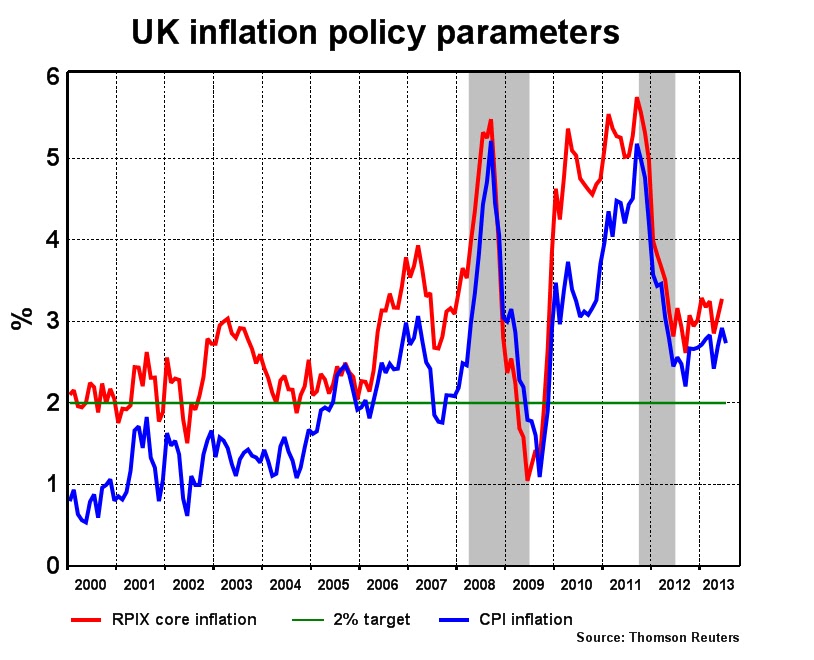
The drop in UK headline inflation from 2.9% to 2.8% will give the UK monetary authorities little to celebrate. The Bank’s new-found forward guidance on interest rates based on unemployment may be one thing, but UK inflation is still stubbornly stuck too high for the BOE’s comfort. The underlying upward tendency in UK inflation amid clearer signs that the UK economy is throwing off the mantle of recession suggests that the Bank is not going to hang around too long with record low rates at 0.5%. There is a very strong chance that the BOE will go along with basic instinct and go for higher rates well before the next UK general election which must be held before May 2015. While the markets have been obsessed with BOE governor Carney throwing more fuel into the recovery, the odds are that the UK’s monetary stimulus tanks are already full to the brim and it may be time fairly soon to take its foot off the accelerator and back onto the brake. The recovery in the UK housing market and rising house price inflation will simply add to the Bank’s concerns that it might need to nip any impending housing bubble smartly in the bud. It is no surprise that the UK pound is starting to get a better spring in its step versus the dollar. The market is starting to get a much strong whiff of an early rate rise in 2014.


Thursday, 25 July 2013

Sound bites: UK economy coming in from the cold in Q2

At long last the UK economy has some welcome news. The economy is coming out of the shadows, with a doubling in its quarterly growth rate from 0.3% in Q1 to 0.6% in Q2. The recovery is not quite on dry land yet, but at least it is a step in the right direction. We need a lot more quarters’ growth like this before the Bank of England’s repair work is done. With so much potential stimulus being drained out of the recovery by the government’s austerity programme, the BOE will need to keep applying its monetary balm for a lot longer. There is no chance of a BOE rate hike before 2015 and the odds of additional tranches of Bank support are still high. The UK economy may be coming in from the cold but there is still a fair degree of warming up to do yet.


Sound bites: Eurozone recovery restrained by negative credit and too slow money supply growth

Eurozone recovery is being severely impeded by negative credit growth. If the ECB wants to release the Eurozone from its recession shackles it must free up a much better supply of credit to the Eurozone economy. The credit crunch is deepening. Bank loans to the Eurozone private sector are contracting at a faster pace, falling by 1.6% in June compared to -1.1% in May. This cannot sustain recovery in any credible shape or form. The detail looks deeply concerning. Bank loans to the corporate sector are contracting at a 3.2% annual pace, while consumer credit is shrinking by 3.6%. It is less a question of getting rates lower or providing extra market liquidity to get the recovery going. The ECB and Eurozone governments need to take a big stick to the banks to get lending going again. It is less a case of draconian bank capital requirements hampering lending, the banks just do not seem to want to lend full stop. The fact that Eurozone money supply has decelerated again to 2.3% in June from 2.9% in May shows the scale of the problem. The reference target rate for M3 money is supposed to be 4.5%, consistent with 2% inflation and 2.5% growth. The ECB is well adrift from that now. It needs to start pump priming very soon or else face disaster for recovery prospects in the beleaguered Eurozone economies


Sound bites: German IFO business climate index building a better head of steam in July

Germany’s IFO index shows that the recovery is gradually getting back into its stride with a little bit more gusto. The economy is starting to build a better head of steam, thanks to the export sector and the fact that consumers seem to be gaining better confidence. If the improvements continue at this rate Germany could see growth upwards of 1% this year and 2% next year. It all still remains conditional on the rest of the Eurozone holding steady and contagion pressures easing. The Eurozone still remains the albatross round the German recovery’s neck. So far so good.


Thursday, 6 June 2013

Sound bites: ECB policy unchanged, but leaving them a lot to do

No surprises that the ECB have left policy unchanged as they wait for the next spark for action. The ECB needs to look no further than the economy for clear signs that they have a lot more easing to do. The Eurozone economy is crying out for easier monetary policy. Inflation and money supply growth falling well below target, the domestic credit contraction and chronic recession all underline that the ECB’s monetary policy settings are still far too tight. Draghi is clearly poised to cut rates again at some stage. The problem is that they are running out of ammunition with lower rates as a policy stimulant. There is probably only one more rate cut bullet left in the bag. The marginal effect of one further quarter point rate cut will be next to nothing other than symbolic.

It is down to much more conventional monetary easing and the introduction of ‘special’ measures to get the recovery underway and to avoid the risk of Eurozone deflation going viral. Germany’s economy may be doing ok and keeping its head above water, but most of the rest of the Eurozone is drowning in recession. It is time to act and act soon. The ECB needs to lubricate prospects for recovery with much better access to cheap credit for consumers and small and medium sized enterprises. The continuing contraction in Eurozone private sector loans underlines that the money already released by the ECB into the system is not getting through to borrowers. This is not a demand problem, but a supply constraint. The banks are keeping back ECB funding for their own prudential balance sheet protection. If the banks are holding up funding going into the economy, then they are starving recovery of vital sustenance. The ECB needs to act on this fast and impose lending incentives for the banks. At some stage, the ECB will also need to exorcise their demons and consider quantitative easing as another vehicle for pump-priming recovery. After all, if it has worked for the US and is starting to bear fruit in Japan, it needs careful consideration in the Eurozone now.